

Athletes rely on powerful, fluid hip motion to sprint, pivot, and rotate, but when mobility is limited or core stability breaks down, the labrum often absorbs the extra stress. Over time, this can lead to irritation, overload, and often labral tears. This post explains how hip mobility and core strength work together to protect the joint and what athletes can do to stay healthy and resilient.
Why Hip Mobility Matters for Labral Health
The hip joint needs smooth, unrestricted movement to distribute forces evenly. When mobility is limited, often due to tight hip flexors, restricted internal rotation, or poor pelvic alignment, the labrum absorbs more stress than it should.
Reduced hip mobility can lead to:
- Increased joint friction
- Compensatory movement patterns
- Higher risk of impingement (FAI), a common precursor to labral tears
Restoring mobility improves joint mechanics, allowing athletes to run, pivot, and jump without overloading the labrum. Surgeons who specialize in hip preservation frequently emphasize early mobility screening for high-demand athletes, especially those in sports like soccer, hockey, and dance.
The Critical Role of Core Strength in Injury Prevention
Core strength is more than a strong set of abs, it means the deep stabilizing muscles of the pelvis and trunk can control movement during dynamic activity. When the core weakens, the hip joint must work harder to maintain stability, increasing shearing forces on the labrum.
A strong core helps:
- Maintain pelvic control during rotational movements
- Reduce dynamic valgus collapse
- Improve load transfer between the spine and lower body
Research consistently shows that poor lumbopelvic stability contributes to hip overuse injuries. Strengthening the transverse abdominis, obliques, multifidus, and gluteal muscles creates a stable base that protects the hip during explosive athletic movements.
How Athletes Can Improve Hip Mobility and Core Stability
A comprehensive injury-prevention program should include both targeted mobility work and progressive strengthening. Examples include:
Hip Mobility Work:
- Internal and external rotation drills: Done by rotating the hip inward and outward, either seated, standing, or lying down, to gently improve the joint’s rotational range.
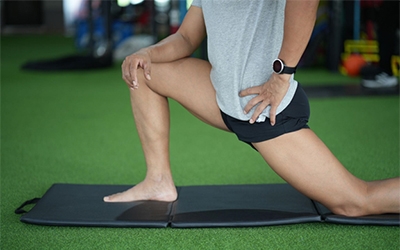
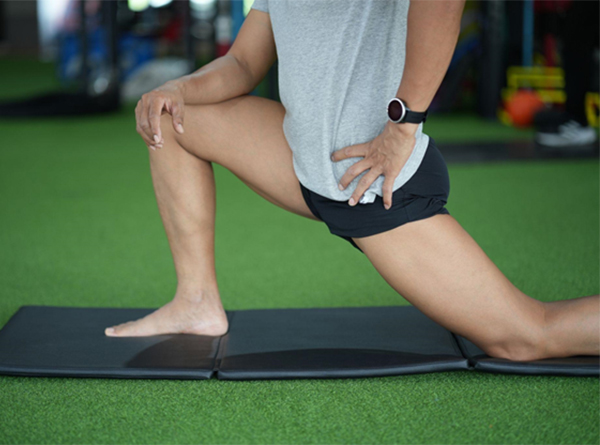
- Hip-flexor mobility exercises: Involve stepping into a lunge position and leaning forward slightly while keeping the torso tall to stretch the front of the hip.
- Controlled articular rotations (CARs): Performed by slowly moving the hip through its fullest possible range of flexion, rotation, abduction, and extension, while maintaining tension and control throughout the motion.
Core and Pelvic Stability Exercises:
- Pallof presses: Performed by holding a resistance band at chest height and pressing it straight out while resisting the band’s pull to the side.
- Dead bugs: They involve lying on your back and alternating opposite arm and leg extensions while keeping your core braced and your lower back stable.
- Single-leg bridges and planks: Done by lifting your hips or holding a plank position on one leg, engaging the glutes and core to maintain alignment.
- Anti-rotation training: Performed by using a band or cable to resist twisting forces while maintaining a steady, square torso.
Combined, these reduce abnormal forces on the labrum and lower the overall risk of tears in competitive athletes.
When to Seek an Evaluation
Athletes experiencing groin pain, catching, clicking, or stiffness that persists through training should not ignore these early signs. An orthopedic hip-preservation specialist can evaluate whether mobility restrictions or early labral irritation may be contributing to symptoms.
AUTHOR: Srino Bharam, MD, MBA, is a board-certified, fellowship-trained sports medicine orthopedic surgeon and professor of orthopedic surgery specializing in the treatment of athletic injuries of the hip and groin. Dr. Bharam has over 20 years of experience in treating injuries and conditions of the hip to restore athletes and patients to an active lifestyle.