


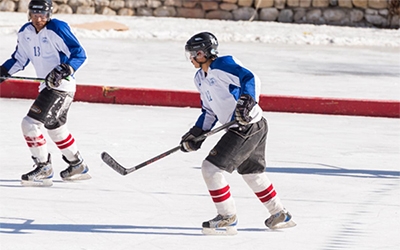

Every Stanley Cup run tells a story of speed, grit, and sacrifice. Fans see the goals, saves, and hits, but not the hidden toll beneath the surface. Hip and groin injuries such as athletic pubalgia and hip impingement can sideline players, shorten careers, and linger long after retirement. Though rarely discussed outside sports medicine, these conditions are among the most significant injuries in hockey. Here is what they are and why players are so vulnerable.
Why Hockey Players Are Uniquely Vulnerable to Hip and Groin Injuries
The skating stride is biomechanically unlike any other athletic movement. It demands extreme hip rotation, deep hip flexion, and forceful adductor engagement with every push-off. Players spend an entire game repeating this motion at high intensity, often while absorbing contact, changing direction abruptly, and twisting through traffic along the boards.
Over a season that stretches from training camp through a potential Stanley Cup playoff run, the cumulative load on the hip joint and surrounding musculature is extraordinary. No other major team sport places the hip and groin under this particular combination of repetitive rotational stress and high-impact collision force. That is why hip and groin conditions account for a disproportionately high share of NHL missed games compared to other professional sports leagues.
Athletic Pubalgia: The Injury That Quietly Derails Seasons
Athletic pubalgia, widely known as sports hernia, is one of the most misunderstood and misdiagnosed conditions in hockey. Despite the common name, it is not a true hernia. It is a disruption of the soft tissue structures in the lower abdominal wall and groin region, typically involving a tear or weakening of the posterior inguinal wall, often occurring alongside injury to the adductor muscles where they attach to the pubic bone.
The defining feature of athletic pubalgia is deep, diffuse groin pain that is aggravated by explosive movements like sprinting, cutting, and shooting. The pain often eases at rest, which leads players and even some clinicians to minimize it initially. Over weeks and months, however, it becomes increasingly difficult to perform at a high level, and the condition rarely resolves fully without targeted intervention. Because the groin region involves multiple overlapping anatomical structures, accurate diagnosis requires a surgeon with specific expertise in this area.
Femoroacetabular Impingement: When the Hip Joint Itself Becomes the Problem
Femoroacetabular impingement, commonly referred to as FAI, occurs when abnormal contact between the ball and socket of the hip joint causes damage to the cartilage and labrum. In hockey players, the repetitive deep hip flexion and rotation required by skating gradually accelerates this contact, leading to pain, stiffness, and eventually labral tears.
Many players skate through mild FAI symptoms for years without knowing the underlying cause. When the labrum tears, the character of the pain often changes, becoming sharper and more localized, sometimes accompanied by a catching or locking sensation deep in the hip joint. Symptomatic FAI with associated labral tears can progress to cartilage damage and may result in hip osteoarthritis.
How These Injuries Are Treated in High-Performance Athletes
The treatment approach depends on the specific diagnosis, the severity of the injury, and the demands of the athlete. Many cases of athletic pubalgia are initially managed with structured physical therapy and activity modification, though surgical repair of the torn soft tissue is often necessary for competitive athletes who need to return to full explosive function.
Symptomatic FAI with labral tears that has not responded to conservative management can be treated with hip arthroscopy, a minimally invasive surgical technique that allows a surgeon to repair or reconstruct the damaged labrum, reshape the impinging bone, and restore normal joint mechanics through small incisions. Recovery timelines vary, but most athletes treated with hip arthroscopy are able to return to sport, with the rehabilitation process typically spanning several months of progressive loading and strengthening.
For groin injuries that involve coexisting hip and adductor pathology, the most effective outcomes come from a comprehensive evaluation that accounts for all contributing structures rather than treating each in isolation.
Frequently Asked Questions About Hockey Hip and Groin Injuries
What is athletic pubalgia and how is it different from a groin strain?
A groin strain is a muscle injury that often heals with rest and therapy. Athletic pubalgia involves deeper damage to the abdominal and groin attachments and may require surgery in competitive athletes.
Can a hockey player keep playing with a sports hernia?
Some players continue temporarily, but symptoms usually worsen with ongoing skating and explosive movement. Delayed treatment can prolong recovery and reduce performance.
What does hip impingement feel like in a hockey player?
Players often feel deep groin or front hip pain during skating, squatting, or prolonged sitting. Sharp pinching with hip rotation is also common.
How long does recovery take after hip arthroscopy for a labral tear?
Most hockey players return to sport within four to six months, depending on the severity of the injury and rehabilitation progress.
Are these injuries only seen in professional hockey players?
No. Athletic pubalgia, labral tears, and hip impingement also affect college, junior, and recreational hockey players because the skating motion stresses the hips at every level.
The Hidden Cost of Playing Through Hip and Groin Pain
The challenge with hip and groin injuries in hockey is that they are frequently underestimated early, either by players reluctant to leave the lineup or by clinicians without specific expertise in this anatomical region. Understanding that these injuries exist and that effective treatment is available is the first step toward better outcomes for players at every level of the game.
Reference Links:
- Associations Between Hip Pathology, Hip and Groin Pain, and Injuries in Hockey Athletes: A Clinical Commentary - PubMed
- Elite Ice Hockey Goalkeepers Have a High Prevalence of Hip and Groin Problems Associated With Decreased Sporting Function: A Single-Season Prospective Cohort Study - PubMed Central
AUTHOR: Srino Bharam, MD, MBA – Hip Preservation & Groin Orthopaedic Surgeon
Srino Bharam, MD, MBA, founder of the Hip Preservation & Groin Center in NYC, is a board-certified orthopaedic specialist with subspecialty certification in sports medicine, dedicated to hip and groin preservation and restoring active, healthy movement. Internationally recognized for master-level expertise in hip care, Dr. Bharam specializes in advanced treatment of hip and groin conditions, helping patients, from athletes to active individuals, return to peak function through comprehensive, patient-centered care.
Credentials & Recognition
Dr. Bharam trained under world-renowned hip surgeon Marc Philippon and completed additional training at Massachusetts General Hospital, where he received the Harvard Partners in Excellence Award for Orthopaedic Trauma Service. He is board certified by the American Board of Orthopaedic Surgery with subspecialty certification in sports medicine.
He serves as a physician consultant to the National Hockey League Players' Association and is a Full Professor of Orthopaedic Surgery. Dr. Bharam is an active fellow of the American Academy of Orthopaedic Surgeons and the American Orthopaedic Society for Sports Medicine, and has been recognized as a Master Instructor in Hip Arthroscopy by the Arthroscopy Association of North America for more than a decade. He is also a member of the International Association for Dance Medicine & Science.
Dr. Bharam has been consistently recognized among the nation's leading orthopaedic surgeons, named a Castle Connolly Top Doctor multiple times, a New York Magazine Top Orthopaedic Surgeon, and one of America's Top Doctors — peer-nominated honors reflecting excellence among the top 7% of U.S. physicians.
Clinical Expertise & Academic Contributions
Dr. Bharam focuses on advanced hip preservation, groin injury management, and sports-related orthopaedic care. He performs surgery at leading institutions including Northwell Health, NewYork-Presbyterian Hospital, Hackensack Meridian Health, and Mount Sinai, as well as ambulatory surgical centers.
A prolific author and investigator, Dr. Bharam has published extensively in peer-reviewed orthopaedic literature and has served as guest editor for Orthopaedic Clinics of North America and Clinics in Sports Medicine. His academic and clinical work centers on improving outcomes, advancing hip preservation techniques, and optimizing return to activity for patients at every performance level.
Medical Disclaimer: This information is provided for educational purposes only and does not constitute medical advice. For diagnosis and treatment recommendations, please consult with Dr. Bharam.