

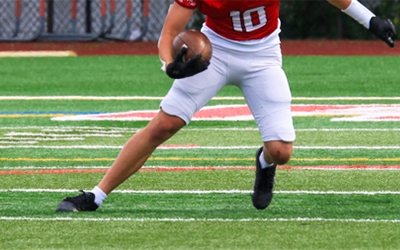
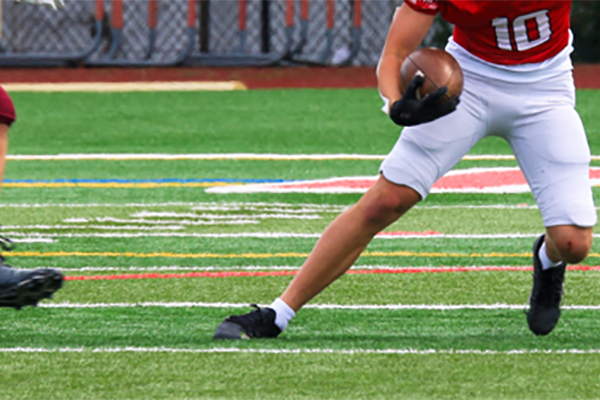
Ask football players whether they would rather play on grass or turf and you are likely to get strong opinions. But the debate is about more than comfort. The surface beneath an athlete's feet can influence how forces are transferred through the lower body, particularly during cutting, acceleration, and changes of direction. Researchers have been examining whether those differences may affect the risk of certain hip and groin injuries.
Why Surface Type Isn't Just a Comfort Issue
Football places tremendous demand on the hip and groin, particularly during cutting, planting, and sudden acceleration. These movements require the foot to grip the ground firmly enough to generate force, but not so firmly that the body cannot rotate safely when a player changes direction. That balance between traction and release is where playing surface enters the conversation.
Natural grass tends to allow a small amount of give at the point of foot contact, letting cleats release more readily during a pivot. Artificial turf, particularly older generations of turf, often provides higher rotational traction, meaning the foot stays anchored to the ground longer during a cutting motion. When the body continues rotating while the foot remains fixed, the resulting force has to go somewhere, and the hip and groin region frequently absorbs it.
The Groin's Vulnerable Anatomy
To understand why this matters so much for football players specifically, it helps to look at the groin itself. This region serves as the junction between the upper and lower body, home to a complex network of muscles, tendons, and the pubic symphysis, all working together to stabilize the pelvis during explosive movement.
The adductor muscles, which pull the leg inward toward the body, are especially vulnerable during the kind of forceful, unplanned direction changes that increased surface traction can produce. Repeated high-traction cutting can place cumulative strain on these structures, sometimes leading to a strain, and in more severe cases, a tear of the adductor tendon at its attachment point.
What the Injury Data Suggests
Multiple studies tracking football players across different surface types have found higher rates of certain lower extremity injuries on artificial turf compared to natural grass, particularly for non-contact injuries involving sudden deceleration or rotation. While ACL and ankle injuries have received the most research attention historically, groin and hip injuries follow a similar biomechanical logic, since both depend heavily on how freely the foot can rotate at the moment of contact.
It is worth noting that turf technology has improved substantially over the years, with newer infill systems designed to more closely mimic the release characteristics of natural grass. Even so, variability between different turf types, field maintenance, weather conditions, and even shoe and cleat selection all interact with surface type to influence overall injury risk, making this a more nuanced picture than simply grass versus turf.
Athletes at Higher Risk Deserve Closer Attention
Not every player who competes on turf will develop a groin injury, and plenty of grass-field athletes experience the same problems. Diagnosing the true cause of persistent groin pain in athletes is notoriously complex, since so many overlapping structures, including the adductors, hip flexors, and even the hip joint itself, can produce similar symptoms. This is exactly why groin pain diagnosis is complex for athletes.
Athletes who play primarily on turf, particularly at the high school and college level where scheduling often dictates surface rather than player preference, may benefit from a more proactive approach to hip and groin conditioning, since the biomechanical demand is measurably different from a grass-only season.
Prevention Strategies Worth Building Into Training
Reducing groin injury risk on any surface starts with addressing the muscles most responsible for absorbing rotational load. A structured strength and mobility program targeting the adductors, hip flexors, and core can improve the body's ability to control sudden direction changes rather than relying entirely on surface traction to do the work.
Cleat selection also plays a meaningful role, since different stud patterns and lengths interact differently with turf versus grass, and a mismatch between cleat and surface can artificially increase rotational traction beyond what the surface alone would produce. Athletes recovering from a previous groin or hamstring and thigh injury should be particularly deliberate about this, since scar tissue and prior strain make these structures more susceptible to reinjury under high-traction conditions.
For players managing recurring symptoms or an unclear diagnosis, an athlete injury assessment and second opinion can help clarify whether ongoing pain is related to surface exposure, a structural issue, or a combination of both.
Frequently Asked Questions
Does artificial turf really cause more groin injuries than grass?
Research suggests artificial turf's higher rotational traction can increase strain on the hip and groin during cutting and pivoting, contributing to higher rates of certain lower extremity injuries compared to natural grass, though surface is one of several contributing factors.1 2
Why does turf feel harder on the body than grass?
Turf generally provides more traction at the point of foot contact, meaning the foot releases less easily during a pivot than it would on natural grass, which can transfer more rotational force into the hips and groin.
Can changing cleats reduce groin injury risk on turf?
Yes. Selecting cleats designed specifically for turf, typically with shorter, more numerous studs, can help reduce excess rotational traction compared to cleats designed for natural grass.
What are early signs of a groin strain in football players?
Tightness or aching in the inner thigh during cutting or sprinting, pain with resisted leg adduction, and discomfort that worsens with continued play are common early signs that should prompt rest and evaluation.
Should athletes who play on turf train differently than those who play on grass?
Athletes competing primarily on turf may benefit from additional adductor, hip flexor, and core strengthening to help the body better control the rotational forces associated with higher-traction surfaces.
Playing surface is just one piece of a larger picture when it comes to groin and hip health in football, but it is a piece worth understanding, especially for athletes dealing with recurring pain. If groin or hip discomfort has been affecting your performance, an evaluation with a specialist experienced in athletic hip and groin injuries can help identify the true source and get you back on the field with confidence.
Reference Links:
- College-to-NFL Stadium Turf Transitions as a Risk Factor for Lower Extremity Non-Contact Injuries in Rookie Players: A 13-Year Cohort Analysis - PubMed Central
- Lower Extremity Injury Rates on Artificial Turf Versus Natural Grass Playing Surfaces- A Systematic Review - American College of Foot and Ankle Surgeons
AUTHOR: Srino Bharam, MD, MBA – Hip Preservation & Groin Orthopaedic Surgeon
Srino Bharam, MD, MBA, founder of the Hip Preservation & Groin Center in NYC, is a board-certified orthopaedic specialist with subspecialty certification in sports medicine, dedicated to hip and groin preservation and restoring active, healthy movement. Internationally recognized for master-level expertise in hip care, Dr. Bharam specializes in advanced treatment of hip and groin conditions, helping patients, from athletes to active individuals, return to peak function through comprehensive, patient-centered care.
Credentials & Recognition
Dr. Bharam trained under world-renowned hip surgeon Marc Philippon and completed additional training at Massachusetts General Hospital, where he received the Harvard Partners in Excellence Award for Orthopaedic Trauma Service. He is board certified by the American Board of Orthopaedic Surgery with subspecialty certification in sports medicine.
He serves as a physician consultant to the National Hockey League Players' Association and is a Full Professor of Orthopaedic Surgery. Dr. Bharam is an active fellow of the American Academy of Orthopaedic Surgeons and the American Orthopaedic Society for Sports Medicine, and has been recognized as a Master Instructor in Hip Arthroscopy by the Arthroscopy Association of North America for more than a decade. He is also a member of the International Association for Dance Medicine & Science.
Dr. Bharam has been consistently recognized among the nation's leading orthopaedic surgeons, named a Castle Connolly Top Doctor multiple times, a New York Magazine Top Orthopaedic Surgeon, and one of America's Top Doctors — peer-nominated honors reflecting excellence among the top 7% of U.S. physicians.
Clinical Expertise & Academic Contributions
Dr. Bharam focuses on advanced hip preservation, groin injury management, and sports-related orthopaedic care. He performs surgery at leading institutions including Northwell Health, NewYork-Presbyterian Hospital, Hackensack Meridian Health, and Mount Sinai, as well as ambulatory surgical centers.
A prolific author and investigator, Dr. Bharam has published extensively in peer-reviewed orthopaedic literature and has served as guest editor for Orthopaedic Clinics of North America and Clinics in Sports Medicine. His academic and clinical work centers on improving outcomes, advancing hip preservation techniques, and optimizing return to activity for patients at every performance level.
Medical Disclaimer: This information is provided for educational purposes only and does not constitute medical advice. For diagnosis and treatment recommendations, please consult with Dr. Bharam.